Like so many of you, we here at PBN watched with heavy hearts the events that unfolded in Minneapolis last week. While it was horrifying to learn of the death of George Floyd at the hands of police, it was not unfortunately a shocking event but rather the latest moment in our nation’s history of violence toward people of color.
And of course, it was natural that Buffalo would join in on the protest. Buffalo has its own complicated racial history. We rightly celebrate our role in the journey to freedom and equality, from our Underground Railroad legacy, the founding of the Niagara Movement, and our African American community’s contributions to civil rights, art, literature, music, architecture, academia, and culture. But we must never lose sight of the darker side of our journey. Buffalo’s current reality is shaped – physically and culturally – by a deep history of racism and racial segregation. Today the legacy of racist government and banking policies and practice, of redlining, of racially motivated disinvestment, has resulted in vast inequalities in housing, education, and quality of life among our citizens.
Of course, as preservationists, it is hard to watch images of destruction of historic property, but we remind our members that we care about the buildings because we care about the people. The people who built them, the people who occupy them, the people whose story they help to tell, and the people who will occupy them in the future. In that spirit, we remember that buildings can be repaired, while loss of life cannot be fixed.
As we determine how to go forward from this moment, PBN believes that historic preservation has an important role to play in helping to bridge inequalities and build understanding within our community. We are committed to ensuring that our work reflects the full and complicated story of our entire community and all of those who have helped to build it. From helping to preserve the places that are the embodiment of specific important events and people, to helping to empower existing communities to tell their own stories and protect their own legacies, to continuing to educate people about the history that brought us to the current moment, we will continue our work, and we will redouble our efforts to ensure that our own work is intentionally committed to dismantling the racist systems we all find ourselves within.
Welcome to Gay Places with Dr. Jeffry Iovannone. PBN’s blog series is dedicated to celebrating and learning more about the historic LGBTQ landmarks of Western New York. With this space we will highlight the work of Dr. Iovannone and other guest writers to provide insight to the LGBTQ history associated with our existing historic built environment- narratives which are frequently forgotten, ignored, or purposely left out.
69 Johnson Park, Buffalo NY By Dr. Jeffry Iovannone
69 Johnson Park, built c.1855, listed on the National Register of Historic Places as part of the West Village Historic District.
69 Johnson Park is an exquisite Victorian house located in downtown Buffalo just south of the historic Allentown neighborhood. A fine example of Second Empire architecture, it is significant to Buffalo history as a contributing resource of the West Village National Register Historic District. The house, however, is noteworthy for more than its Victorian-era authenticity. It is also one of the many places in Western New York that is significant to the LGBTQ history of the Buffalo-Niagara region.
69 Johnson Park is a two-and-one-half story Second Empire style brick residence. Representative of the style, it features round arch windows topped with decorative keystones, a richly dentilled and bracketed wide overhanging eaves, molded cornices, and is topped by a Mansard roof with round arched dormer and porthole windows. The main entry is accented by a one-story, wrap around porch supported by square columns and an open rail of square balusters.
Second Empire style was popular in the United States from 1855-1885, contemporaneous to the equally popular Italianate and Gothic Revival styles. While the latter styles were part of the Picturesque movement, which looked to the romantic past of architecture for inspiration, Second Empire style was considered very modern, as it drew from new and fashionable French architecture. The name Second Empire actually refers to the reign of Napoleon III (1852-1870), which was known as the Second French Empire. While Italianate and Second Empire drew from different influences, they share many character defining features, including wide overhanging eaves, tall narrow round arched windows, and molded cornices. The major difference between these styles is the use of the mansard roof. Italianate buildings usually have hipped or gabled roof forms, but Second Empire style buildings are defined by their mansard roofs, essentially a dual-pitched hipped roof. Or more whimsically, an overly large ornamental top hat.
Built circa 1865 for the Chamot family, the residence was originally known as 17 Park Place. Patriarch Christopher P. Chamot was a cobbler who, according to an ad from the 1866 Buffalo City Directory, manufactured “ladies’ and men’s theatrical boots and shoes” at 269 Washington Street. Chamot and his wife, Eugenie Monin Chamot, had immigrated to Buffalo from their native France.
The Chamots’ daughter, Lydia, taught at the Buffalo State Normal School (now SUNY Buffalo State) and lived at 69 Johnson Park until her death in 1936. Her sister, Eugenie L. Chamot, who for many years was head of the French department at Masten Park High School (now City Honors), also lived at the house until her death in 1948 at age 92. The sisters were survived by their brother, Dr. Emile M. Chamot, a professor of chemical microscopy and sanitary chemistry at Cornell University.
The Chamot sisters may have taken on borders at 69 Johnson Park, but after their death the property was fully converted into a rooming house. It functioned as such until the 1970s, when it was rehabbed back into a single-family home, likely by then-owner Donald G. Lee. In December of 1983, Lee sold the property to Dr. James D. Haynes who, along with his partner Donald A. Licht, returned the house to its nineteenth-century splendor, both outside and in. Haynes and Licht were not only self-taught preservationists—they were two of Buffalo’s most prominent gay rights activists.
Haynes, who was originally from Poplar Bluff, Missouri, and completed a doctorate in Biology from Iowa State University, came to Buffalo in 1967 when he was hired as an associate professor at Buffalo State College. That same year, he met Licht, an Anthropology student at the University at Buffalo, at T&T’s Western Paradise, a short-lived gay bar located at 1239 Niagara Street.
James Haynes with friends. Photo courtsey of The Dr. Madeline Davis LGBTQ Archive of Western New York, Archives & Special Collections Department, E.H. Butler Library, SUNY Buffalo State.
In the late 1960s, the pair helped found the Mattachine Society of the Niagara Frontier (MSNF), Buffalo’s first gay and lesbian civil rights organization. The original Mattachine Society was founded in Los Angeles in 1950, and the name became synonymous with early gay rights groups. The Mattachine were an underground medieval French fraternity who gave public performances that challenged social customs. Early gay rights pioneer Harry Hay chose the name because Mattachine troupes conveyed vital information to the oppressed in the French countryside. The modern Mattachine Society, similarly, sought to bring knowledge to oppressed American homosexuals. The Mattachine Society was the first gay organization of its kind to have longevity, and during the 1950s and ‘60s chapters proliferated throughout the country.
Haynes was the first chair of MSNF’s Health Committee and worked, alongside Licht, to develop a peer-counselor training program and hotline that was adopted by gay and lesbian organizations beyond Buffalo. Richard McGinnis, a MSNF member during the early 1970s, refers to Jim Haynes as “The Whampanator.” He uses this expression to describe how Haynes was the beating heart of Buffalo’s gay community—a leader with compassion, drive, and determination who motivated others and got things done.
Licht assisted MSNF in several capacities over the organization’s lifetime (1970-1984), serving as its vice president, treasurer, and chair of social planning. Haynes and Licht were joint members of MSNF’s Speakers Bureau and spoke to audiences throughout Western New York on gay and lesbian civil rights and liberation.
MSNF reunion October 12, 1991. (Front left to right) Bruce Greenberg, Don Licht, Jim Haynes, Eileen Katz, Bobbie Prebis, Madeline Davis, Rchard Roeller; (Back left to right) Unknown, Unknown, Don Cichaels, Richard McGinnis, John Yanson, Peggie Ames, Bob Brosius. Photo courtsey of Bruce Greenberg and Richard McGinnis.
During the 1980s, Haynes, who began studying the HIV/AIDS pandemic, helped co-found the Western New York AIDS Program (today Evergreen Health Services) and, with Licht, Mark Boser, Tom Hammond, and Robert Uplinger, Gay & Lesbian Youth of Buffalo (now Gay & Lesbian Youth Services of Western New York). In 1986, Haynes was appointed by New York State Governor Mario Cuomo to the Governor’s Task Force on Gay Issues. After MSNF folded, the couple became active members of the Buffalo Gay and Lesbian Community Network, co-founded by Carol Speser and Larry Peck. In addition to their activism, Haynes and Licht were known for hosting period-authentic Victorian holiday parties at their recently purchased Johnson Park home that featured an evergreen tree decorated with real candles lit in a meticulous and ceremonial fashion.
Not only did the pair work tirelessly to preserve 69 Johnson Park, but LGBTQ history in Buffalo. In 2001, they helped found the Madeline Davis GLBT Archives of Western New York, now housed in SUNY Buffalo State’s E.H. Butler Library. Haynes passed away on November 9th of 2008. Licht, who remains in Buffalo, sold their home of nearly four decades in 2019. This stunning Victorian-era residence remains as a reminder of Buffalo’s former glory and, often unacknowledged, LGBTQ history.
* * *
Dr. Jeff Iovannone is an historian, writer, educator, and third-generation Buffalonian who holds a Ph.D. in American Studies, specializing in gender and LGBTQ studies. He is currently at work on a book about Buffalo’s gay liberation movement from the late 1960s to the early 1980s and is an avid collector of LGBTQ historical materials. He is the coordinator of the Women’s and Gender Studies Program at SUNY Fredonia and a board member of the Buffalo-Niagara LGBTQ History Project. You can find more of his writing on Medium at medium.com/@jeffry.iovannone.
* * *
69 Johnson Park Bibliography
Atlas of Greater Buffalo. Philadelphia: Century Atlas Company, 1915.
Atlas of the City of Buffalo. Buffalo: Hopkins Publishing, 1872, 1884, 1891.
“C.M. Chamot Named Exchange Professor.” Buffalo Evening News (Buffalo, NY), May 7, 1924.
James Haynes and Donald Licht Papers, Dr. Madeline Davis LGBTQ Archive of Western New York, Archives & Special Collections Department, E. H. Butler Library, SUNY Buffalo State.
Ross, Claire L. “West Village Historic District,” National Register of Historic Places Nomination Form. Washington, DC: US. Department of the Interior, National Park Service, 1980.
“Miss Chamot is Dead at 92; Was Teacher.” Buffalo Courier-Express (Buffalo, NY), Mar. 9, 1948.
Roscoe, Will. “The Radicalism of Harry Hay.” Gay & Lesbian Review Worldwide Vol. 20 Issue 6 (Nov/Dec 2013): 11-14.
Bruce Greenberg and Richard McGinnis with author, January 8, 2020.
Carol Speser with author, October 5, 2018.
Donald Licht with author, October 9, 2018.
The Historical Development of the Gay Community in Buffalo, NY, interview by Justin Azzarella, April 11, 2002, Dr. Madeline Davis LGBTQ Archive of Western New York, Archives & Special Collections Department, E. H. Butler Library, SUNY Buffalo State.
Jim Haynes and Don Licht, interview by Keith Gemerek, 2004, Dr. Madeline Davis LGBTQ Archive of Western New York, Archives & Special Collections Department, E. H. Butler Library, SUNY Buffalo State.
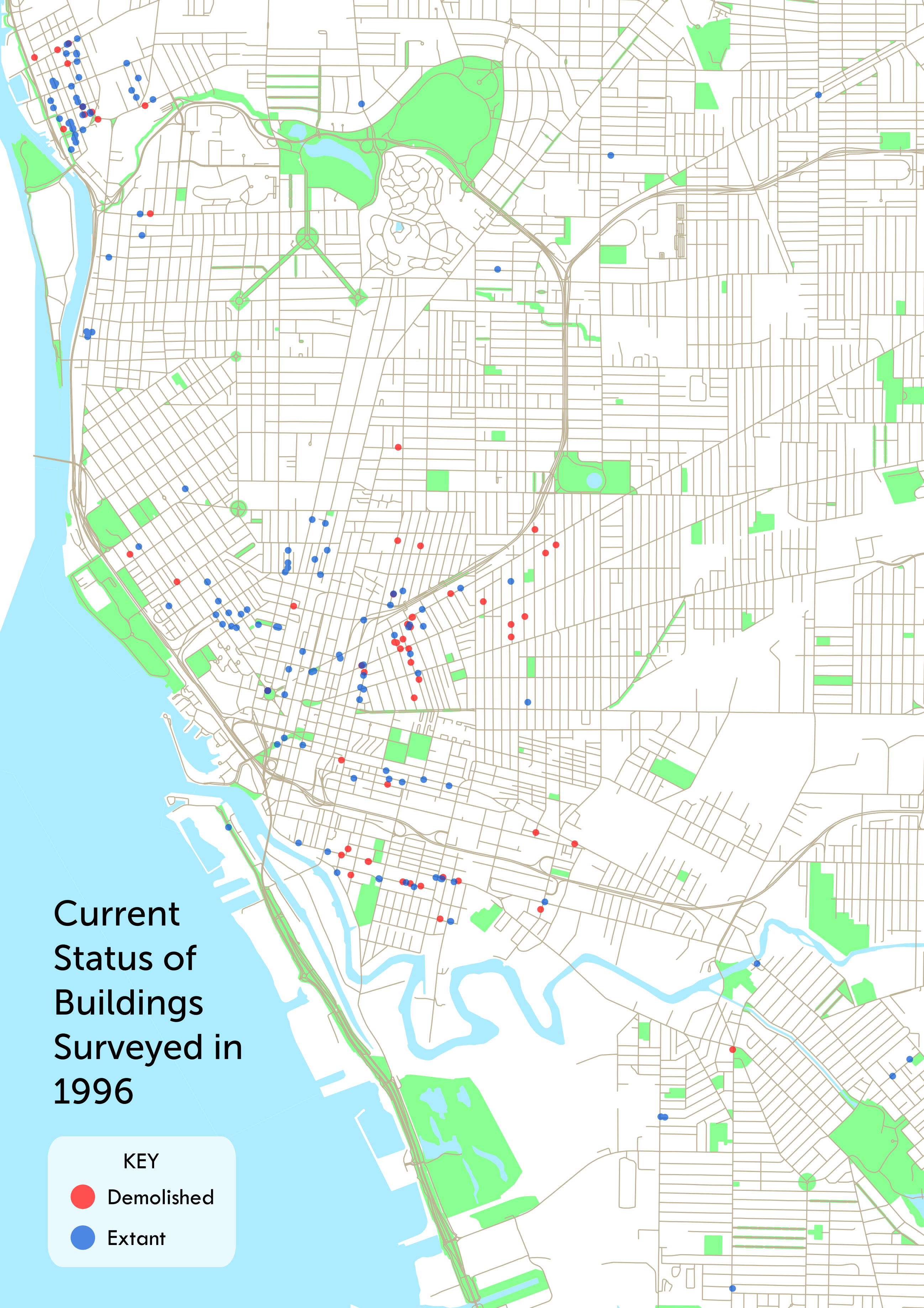
In 1996, titans of Buffalo’s preservation community, including John Conlin, Edward J. Patton, and Paul Redding, were commissioned by then Common Council President George K. Arthur to identify structures in the City of Buffalo built prior to 1860. The resulting list included approximately 215 buildings, with the oldest from 1818. PBN recently acquired this 25-year-old survey and has found that nearly 30% of the structures then identified have been lost in the intervening years. Of the remaining structures, over 80% have no formal historic designation or protection.
CALL TO ACTION
Are you looking for a way to support preservation even while social distancing? Now’s your chance to join The 1850 Project and help us research these buildings and put proper preservation protections in place!
HOW TO VOLUNTEER
Step 1: Fill out the form below.
Step 2: PBN staff will be in contact with all the virtual training you need to conduct and document your research from the comfort of your home.
Step 3: Go forth and research! PBN staff will be in regular contact to see how it’s going and answer any questions you might have.
Step 4: Submit your research to PBN staff for review and instructions on how to help transform your research into a landmark nomination or an eligibility review for the National Register of Historic Places.
Step 5: Revel in the satisfaction of knowing you helped protect and preserve these
irreplaceable resources. And then maybe
get started on a second property!
Preservation Buffalo Niagara (PBN) submitted an application to the City of Buffalo Preservation Board to expand the Local Historic District centered around Michigan and Sycamore Streets downtown.
The current district includes properties at 68, 72, and 82 Sycamore Street as well as at 608 Michigan Avenue. The proposed expansion will include properties at 63, 67, & 77 Sycamore Street and 578, 582, & 588 Michigan Avenue.
These properties were built in a time period spanning from 1847 – 1929 and as a collection show the evolution of Buffalo from a raucous canal town to an industrial city, especially depicting the role of immigrants (both from abroad as well as from the American South) in building Buffalo.
During the most recent virtual common council hearing on the proposed Michigan Sycamore Historic District, Common Council President Darius G. Pridgen and PBN’s Christiana Limniatis discussed how landmarking status will and will not affect properties and renovations. Additionally, President Pridgen pledged his support for the nomination and the preservation of the Michigan Street African American Heritage Corridor.
The application was tabled due to issues with notices sent to involved property owners. However, PBN expects the application to be approved at the Legislation Committee’s next meeting on November 4 and then forwarded to the Common Council for a full vote.